SOUTH POLL CATTLE
A Cow Designed to Work With the Land
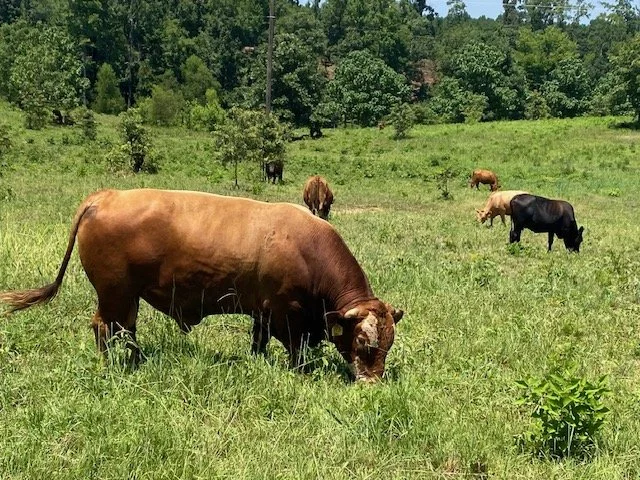
At Youngblood Farm, we don't believe bigger cattle automatically mean better cattle. We want a moderate, deep-bodied cow that can maintain herself on forage, raise a calf, breed back and do it again year after year. That's one reason South Poll cattle fit naturally into our regenerative farming system.
Developed by Teddy Gentry in Alabama, the South Poll combines four maternal Bos taurus breeds—Red Angus, Hereford, Senepol and Barzona. The goal was a heat-tolerant, gentle, fertile animal capable of performing efficiently in a grass-based system.
THE SOUTHERN MAMA COW
South Polls are sometimes called the “Southern Mama Cow,” and that description gets to the heart of the breed.
Rather than emphasizing maximum mature size, the breed was developed around traits important to a productive cow-calf operation: fertility, longevity, maternal ability, moderate size, good udders, calm temperament and the ability to maintain condition on forage.
What we value in a South Poll: moderate frame • deep body • easy fleshing • fertility • sound udders • maternal instinct • docility • heat adaptation • longevity • forage efficiency.
Why Moderate Cattle?
For a forage-based operation, the goal isn't necessarily the biggest individual cow. A moderate cow has lower maintenance requirements than a much larger animal, and the South Poll breeding philosophy deliberately places fertility and longevity ahead of simply selecting for maximum growth. Teddy Gentry discusses that philosophy in the association's recent South Poll Grazier publication, cautioning that continually selecting for greater growth can work against the fertility and longevity the breed was designed around.We want cattle shaped by their environment—not cattle that require us to continually change the environment to accommodate them.
CATTLE + GRASS + SOIL
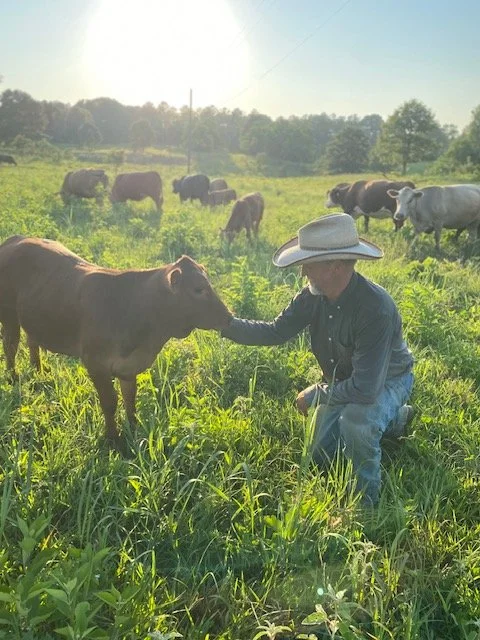
Our cattle aren't separate from our land-management plan. They're part of it.
Managed grazing allows us to use cattle as a tool within the larger farm ecosystem. Our goal is to grow diverse forage, keep living roots in the soil, cycle nutrients through the farm and give grazed areas adequate recovery before cattle return.
So when we evaluate cattle, we're not only asking “How does she look?”
We're asking:
Can she perform in our environment? Can she maintain condition on forage? Is she fertile? Is she calm? Does she raise a good calf? Does she fit the land and management system we're trying to build?